
Evaluating pressurised pipelines as an alternative for open irrigation canals
Research Reports
Latest
A new Rand Water Research, Development and Innovation Hub @ UP-supported study has developed a practical framework to help water managers assess whether ageing open irrigation canals can be converted into modern pressurised pipeline networks.
The paper, authored by Sana Jina, Professor Marco van Dijk and Dr Ione Loots from the University of Pretoria’s Department of Civil Engineering, focuses on one of the most important but often overlooked parts of the water system: the infrastructure that moves irrigation water from source to farm.
Agriculture is the largest user of freshwater globally. In many irrigation schemes, especially in water-scarce regions, water is still transported through open canals. South Africa has an extensive canal network spanning over 6 500 km, with 47 major schemes. These systems are simple and familiar, but they can lose significant volumes of water through seepage, evaporation, leakages and operational spillages before the water reaches farmers. As climate variability increases and competition for water grows, improving the efficiency of existing irrigation infrastructure becomes an increasingly important part of water security.
The study asks a practical question: when does it make sense to replace or modernise open canal conveyance with a pressurised pipeline network?
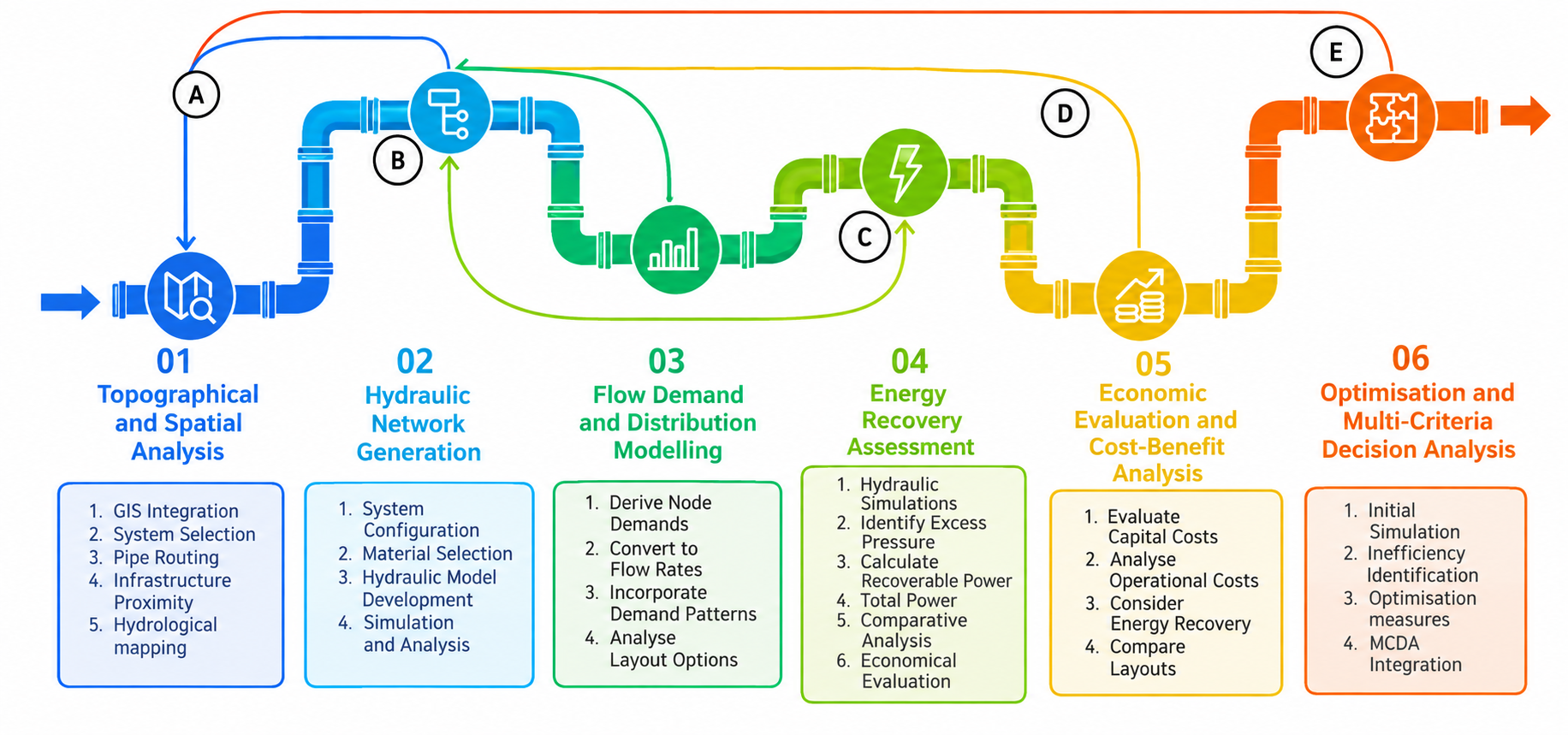
Rather than treating this as a purely engineering design problem, the researchers developed an integrated decision-making framework. The framework combines spatial analysis, hydraulic modelling, water-loss reduction, pressure management, energy assessment, economic analysis and multi-criteria decision-making. This allows planners to compare different pipeline routes and operating scenarios, not only on cost, but also on water savings, reliability, pressure control, energy use and long-term sustainability.
“In a water-scarce country like South Africa, we cannot afford to overlook the water that is lost before it even reaches the point of use. Improving the efficiency of irrigation conveyance is therefore an important part of strengthening long-term water security.” Sana Jina, lead author.
The framework was tested on a large irrigation system in the Letaba region near Tzaneen in Limpopo. This area is supplied from Tzaneen Dam on the Groot Letaba River and supports intensive agricultural production, including citrus and subtropical crops. The existing system relies largely on the river, weirs and gravity-fed canal conveyance, while many farmers still need to lift water into their own on-farm irrigation systems.
Using GIS-based spatial analysis and hydraulic network simulations, the study tested possible pipeline layouts and several design scenarios. The assessment indicates that converting canal systems to pressurised pipelines could reduce conveyance losses by approximately 15%, while improving pressure regulation, flow control and supply reliability. In gravity-fed systems with favourable topography, pressurised pipelines can also reduce pumping requirements. Where excess pressure occurs, that otherwise wasted hydraulic energy can potentially be recovered through small hydropower technologies..
This is important because irrigation modernisation is often judged mainly on capital cost. The study shows that initial investment costs need to be weighed against longer-term benefits: water saved, energy use reduced, better operational control and the possibility of recovering energy from pressure that would otherwise be wasted. The authors found that, under the assumptions tested, several pipeline configurations showed favourable long-term economic performance.
“For me, irrigation modernisation is about much more than simply replacing a bulk supply canal with a pipeline. We need to look at the whole system and ask whether we can save water, use energy more efficiently, improve the reliability of supply and ultimately develop a solution that makes both technical and economic sense. This framework gives us this structured way to evaluate those trade-offs before major infrastructure investments are made.” says Prof Marco van Dijk
For the Rand Water Hub, the study is an example of the kind of applied research needed to connect water science, infrastructure planning and operational decision-making. Although the case study is agricultural, the broader lesson is relevant across the water sector: infrastructure choices should be evaluated as part of a wider water-energy-economic system, rather than through a single measure such as construction cost. As part of the next phase of the research, the team will also draw on Rand Water’s extensive knowledge and practical experience in the planning, design and operation of large-diameter pipeline systems.
The authors are careful to note that the work is a pre-feasibility assessment, not a final engineering design. Further work would be needed to test field performance, refine cost assumptions, assess transient pressures and include more detailed lifecycle emissions. Even so, the study provides a replicable framework that can help water managers and planners compare options more transparently.
As South Africa faces increasing pressure on its water resources, improving the performance of existing conveyance systems will become more important. This research shows that canal-to-pipeline conversion, when carefully planned, can be more than an infrastructure upgrade. It can be a water-saving, energy-aware and climate-relevant intervention for agricultural water security.
https://www.linkedin.com/in/sana-jina-7383b5233/
https://www.linkedin.com/in/marco-van-dijk-a17a8032/
https://www.linkedin.com/in/ione-loots/
#IrrigationModernisation #WaterSecurity #WaterEngineering #WaterEfficiency #WaterEnergyNexus #PipelineEngineering #SustainableAgriculture